

A Canada Federal Court judge has dismissed an urgent motion brought by Ghanaian international footballer Thomas Teye Partey, ending his attempt to secure immediate entry to Canada ahead of the 2026 FIFA World Cup fixtures on Tuesday in Ontario.
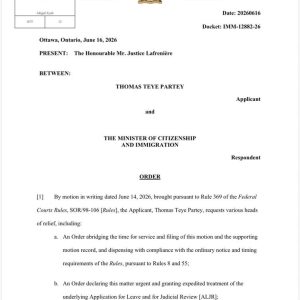
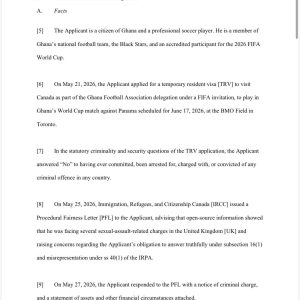
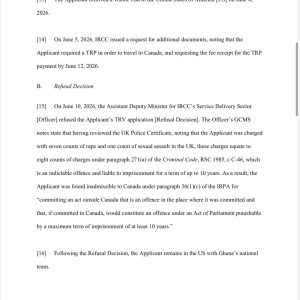
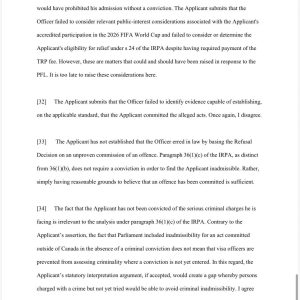
The application arose after Canadian immigration authorities refused his visa on inadmissibility grounds under paragraph 36(1)(c) of the Immigration and Refugee Protection Act (IRPA), which allows findings of serious criminality where there are reasonable grounds to believe an offence has been committed, even in the absence of a conviction.
Court rejects request for emergency intervention
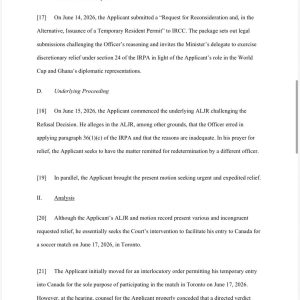
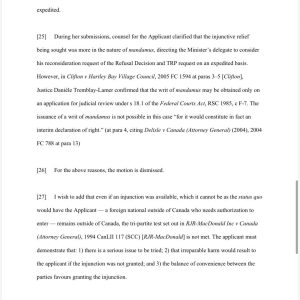
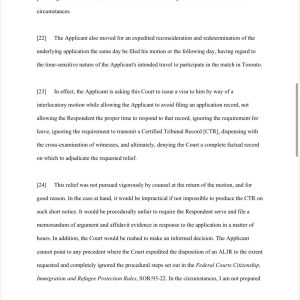
The applicant, Partey, sought interlocutory relief in the form of an order compelling immigration authorities to expedite reconsideration of the refusal decision and to urgently process a Temporary Resident Permit (TRP). Although framed as an injunction, the Court found the relief sought was, in substance, akin to mandamus.
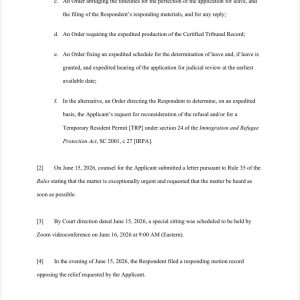
Relying on established Federal Court authority, the judge held that mandamus cannot be obtained outside a proper judicial review framework and cannot be used to compel administrative decision-making on an accelerated basis. The Court further emphasized that granting such relief would effectively amount to an interim declaration of entitlement to enter Canada.
No serious issue established
Applying the RJR-MacDonald test, the Court first found that no serious issue had been established. The judge accepted the Respondent’s position that immigration officers are entitled to rely on “reasonable grounds to believe” under IRPA s.36(1)(c), and are not required to wait for a conviction before making inadmissibility determinations.
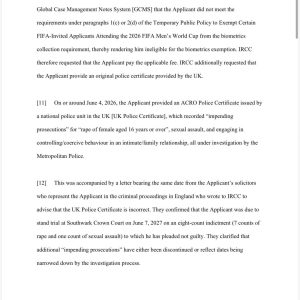
The Court further found that it was open to the visa officer to rely on the allegations contained in the foreign indictment when assessing admissibility. The Applicant’s argument that comparative foreign law, such as United States immigration provisions, should influence the interpretation of IRPA was rejected as irrelevant to the statutory framework governing Canadian immigration decisions.
Procedural fairness arguments dismissed
The Court also rejected claims that the decision was procedurally unfair. It found that the applicant, Partey, had been specifically notified through a procedural fairness letter that his admissibility was in question due to ongoing criminal proceedings abroad. Despite this, the Court noted, the Applicant did not meaningfully address the concerns or provide sufficient evidence to rebut them.
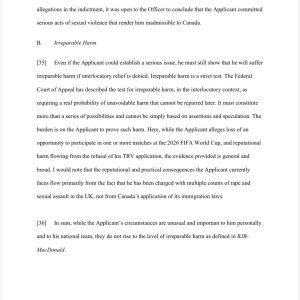
No irreparable harm proven
On the second branch of the test, the Court held that the Applicant failed to demonstrate irreparable harm. While acknowledging the importance of participation in international sporting events and potential reputational consequences, the Court found the evidence was largely speculative and insufficient.
The judge further noted that much of the reputational harm alleged stemmed not from the immigration decision itself, but from the broader context of ongoing criminal allegations in the United Kingdom, which could not be attributed solely to Canadian authorities.
Balance of convenience favours the public interest
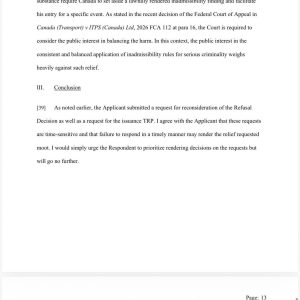
Finally, the Court held that the balance of convenience strongly favoured maintaining the status quo. The decision emphasized the importance of preserving the integrity of Canada’s immigration system and respecting Parliament’s intent in creating a robust inadmissibility regime under IRPA.
Granting the requested relief, the Court found, would improperly interfere with lawful administrative decision-making and undermine the public interest in consistent enforcement of immigration rules relating to serious criminality.
Conclusion
The Court dismissed the motion in its entirety, concluding that none of the three requirements under the RJR-MacDonald test had been met.
However, the judge noted the time-sensitive nature of the Partey’s pending reconsideration and TRP requests and encouraged immigration authorities to process them expeditiously, while making clear that no further judicial intervention would be granted.
The ruling leaves the visa refusal in place, meaning the Partey remains inadmissible to enter Canada unless future administrative relief is granted and he can’t take part in Ghana’s game against Panama or even when the Black Stars progress to the next stage of the tournament.